The Sirens' Call Review: How the Attention Economy Explains Trump, Tech and Social Media
Last week, the Norwegian government put forward a new bill. If it passes, social media will be banned for children under 16. But is that really the right fix for a social problem?
Right now, it's easier than ever to shout — and harder than ever to be heard.
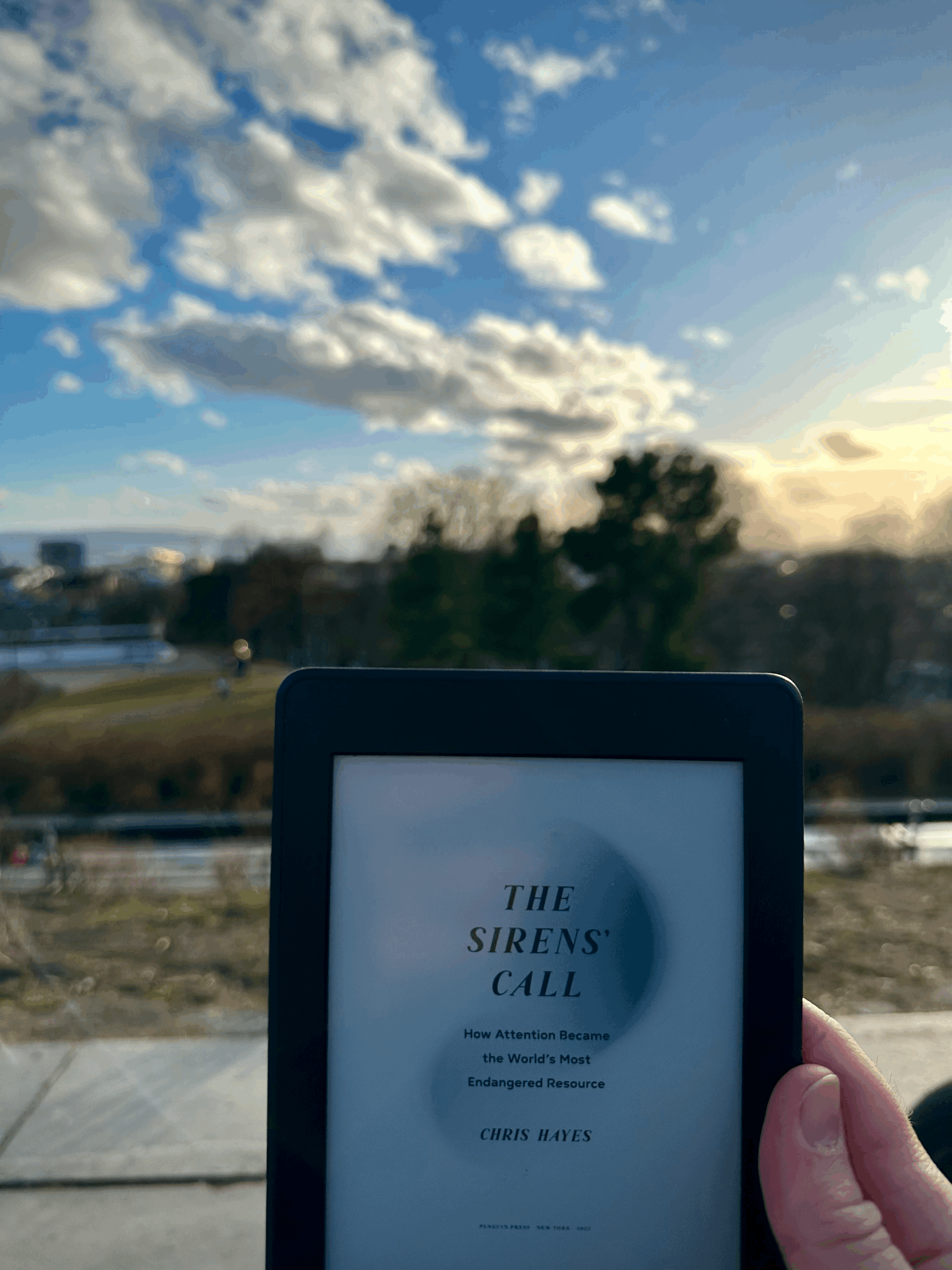
That's what Chris Hayes writes in his book The Sirens' Call. Hayes is best known as a presenter on MSNBC in the US, where his face is a regular fixture several evenings a week with the show All In with Chris Hayes. And perhaps there's no better person than a TV presenter to write a book about our attention — and just how bad things have got.
The Sirens' Call is the kind of book that slightly irritates everyone around you, because when you're reading it you get the urge to shout "Oh, listen to this!" every other sentence. Hayes has packed the book with fascinating facts about how you, I, and everyone else both capture and give away attention.
He's also included a stack of references, many of them used to reinforce his arguments or teach you something new. One central question he tries to answer is: how does Donald Trump command so much attention?
According to Hayes, the answer might lie in this: entertainment will always outcompete information. And spectacle will always outcompete argument.
The easier something grabs our attention, the lower the "cognitive load" — and the more drawn to it we become. Just think how much easier it is to switch on a TV series than to pick up a book. Or how much easier it is to unlock your phone and jump on Instagram rather than sit down and watch TV.
Hayes argues that Donald Trump uses the same trick. In the aftermath of Hamas's attack on 7 October 2023, then-President Joe Biden backed Israel's military response. As Israel continued its brutal campaign, more than half of the people who had voted for Biden in 2020 said Israel was now committing genocide — and an increasing amount were critical of how the country had responded.
You'd have thought this would become a central issue in the 2024 race for the most powerful job in the world. But when asked how Donald Trump felt about Israel's response, the answer was essentially: "If I'd been president, none of this would have happened."
Trump also claimed he was going to end Russia's invasion of Ukraine "within a day." People believed him. And people voted for him. Not because he had good policies, or carefully considered solutions, but because he gave people something easier to digest than information and argument: spectacle and entertainment.
That, Hayes argues, is how Donald Trump and his political machinery managed to reach voters along the path of least resistance. Three months after becoming president, Donald Trump said he'd only been "joking and exaggerating" about ending the war within his first twenty-four hours.
Valuable currency
The Sirens' Call is a genuinely great book. Hayes goes on to pull out example after example of just how fragile — but also how valuable — our attention is. He explains why news articles, and especially opinion pieces, trend on social media. He asks you to notice how often they polarise, or stoke anger and outrage.
My mind goes to a story from April, about the leader of KrFU — the youth wing of Norway's Christian Democratic Party — who called for the 1st of May to be scrapped as a public holiday. For a full day afterwards, my Facebook wall was covered in photos of their party leadeIngrid Olina Hovland's stern expression, usually accompanied by furious posts about how foolish her proposal was.
But, Hayes writes, if you pick up the print edition of the same newspaper, it's entirely different stories that get the most space. That's where you can actually learn something, rather than just getting wound up. It's why he's gone back to print newspapers, where the opinion pages tend to be right at the back.
And perhaps that is why I have a particular soft spot for the print edition of the Norwegian weekly Morgenbladet every Friday.
The Sirens' Call is good at reminding us why attention is so valuable. Not just for the tech giants running Facebook, X, LinkedIn, TikTok and the rest — but for TV channels and websites and books and radio and everything else we surround ourselves with. Because when it comes down to it, attention is what we're giving away:
A good friend who asks for your advice gets your attention. A teacher asks for focus from their students. And right now, as you read this, it's me who's benefiting from yours.
An important reminder
The Sirens' Call came out in January 2025. And since then it's been on my must-read list. I'd half-expected the book to be a torchlit march against Big Tech — a tour de force on how they've dragged us into algorithmic dependency. But Hayes goes deeper than that. There's no wagging finger telling you to stop scrolling.
Instead, the book works as a wake-up call. A reminder. That your attention is worth a lot — because it's really all you have. Hayes takes us through history and shows how the battle for your time has escalated. From the ads that land in your letterbox to the push notifications on your phone. He explains in plain terms how our brains are wired to find shortcuts and a frictionless daily life — and how politicians and tech oligarchs have learned to exploit that.
Let us be entertained
A sad but relevant example Hayes gives happened in the summer of 2023:
On June 14th 2023, more than 500 people drowned when a boat carrying refugees capsized off the coast of Greece. Four days later, on June 18th, a submersible carrying five people disappeared on its way to view the wreck of the Titanic.
I'm not comfortable with this kind of comparison, because it pits human lives against each other. That's an impossible discussion. But as Hayes points out, the submersible had something else about it that kept us all glued to live streams of the rescue operation.
The sub had ninety-six hours of oxygen, and a massive operation was launched involving actors from several countries. On top of that, it was heading for the world's most famous shipwreck. The question everyone was asking: what's going to happen to the people trapped inside that tiny vessel?
A number of news outlets — including Norwegian ones — ran animations showing what the inside of the sub looked like, and how cramped the space was. There were reports about the joystick the pilot used to steer it, and explanations of how an implosion would have compressed the bodies of the people trapped inside the "tin can." In other words: the whole thing played out like a real-life thriller.
I'm fairly sure very few people caught the news about the 500+ refugees who drowned, searching for a better life. I hadn't — until I read Hayes's book.
It's examples like these that remind us how media and social media press every possible button in your brain. Luring you in with tension and division and anger and scandal.
That's why finishing Hayes's book felt like an achievement.
I could have scrolled instead.
Thank you for your attention.